Navigate restaurants with celiac disease using collaboration. Learn to communicate your needs effectively.
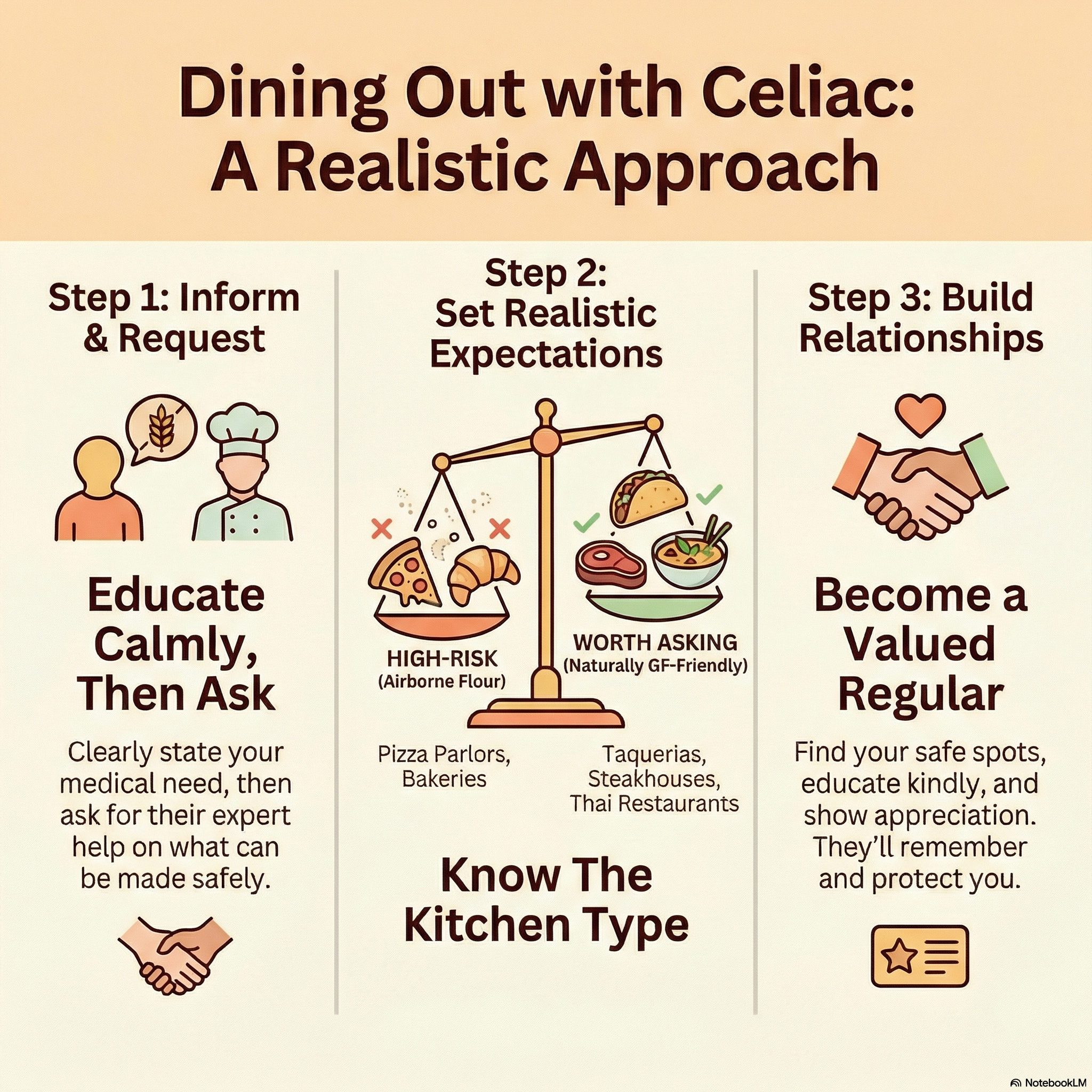 A collaborative approach to navigating restaurants with celiac disease
The Problem with the “Checklist” Approach
Many celiac dining guides tell you to interrogate restaurants: Do you have a dedicated prep area? Do you use separate fryers? Can you guarantee no cross-contact?
Here’s the reality: most restaurants will say no to all of that. And now you’ve created an adversarial situation before you’ve even ordered.
There’s a better way.
Start the Conversation Right
Instead of a checklist of demands, start with education and collaboration:
“Do you know about celiac disease?”
Most servers will say they’ve heard of it, or they’ll ask what it is. This is your opening.
“It means I can’t have any gluten at all—not even a microscopic amount. Gluten is essentially poison to my body. Even a crumb from a shared surface will make me sick.”
This isn’t dramatic. This is accurate. And it helps them understand why you’re asking. If you want to brush up on how to explain gluten clearly, our complete guide to understanding gluten breaks down the science in plain language.
Ask What They CAN Do
Instead of asking if they have specific accommodations (which puts them on the defensive), ask:
“Is there anything on the menu that can be prepared with absolutely no contact with gluten? I’m happy to hear your suggestions.”
This shifts the dynamic. Now they’re problem-solving with you, not defending themselves against you.
Good follow-up questions:
- “Do you have any pre-packaged gluten-free items?”
- “Could the chef prepare plain grilled chicken with no marinade on a clean surface?”
- “Is there a rice dish that doesn’t touch anything with wheat?”
Know Your Restaurant Types Before You Go
 Choosing the right type of restaurant makes all the difference for safe dining
Not all restaurants are created equal when it comes to celiac safety. The key factor: loose flour.
Likely Safe — Worth the Conversation
Taquerias and Mexican restaurants
- Corn-based cuisine (corn tortillas, not flour)
- No loose flour being used in the kitchen
- Many naturally gluten-free options
- Worth educating staff—they may be able to accommodate easily
Thai restaurants
- Rice-based dishes are common
- Ask about soy sauce (request tamari or no soy sauce)
- Curries and stir-fries can often be made safe
- Pad Thai may use wheat-based soy sauce—ask
Indian restaurants
- Many rice-based dishes
- Lentils and vegetables are naturally safe
- Avoid naan and samosas
- Tandoori meats are often safe (verify marinade)
Steakhouses
- Plain grilled steak is inherently safe
- Baked potato, no toppings
- Steamed vegetables
- Avoid sauces and marinades
Sushi restaurants
- Sashimi (plain raw fish) is safe
- Bring your own tamari for dipping
- Avoid anything with soy sauce, tempura, or imitation crab
- Be cautious of cross-contact on cutting boards
Probably Not Safe — Don’t Expect Accommodation
Pizza parlors
- Flour literally covers everything
- It’s in the air, on every surface, in the ovens
- Even “gluten-free” pizzas are often cross-contaminated
- Unless they have a dedicated gluten-free kitchen, assume it’s not safe
Bakeries
- Airborne flour settles on everything
- Even items that don’t contain gluten are contaminated
- A bakery with “gluten-free options” is still a bakery
- The environment itself is the problem
Italian restaurants
- Pasta water contaminates everything
- Flour dust from fresh pasta
- Shared cooking surfaces and utensils
- Very difficult to get a truly safe meal
Any restaurant that uses bags of flour
- When flour is poured, it becomes airborne
- Particles settle on surfaces for hours
- No amount of cleaning fully removes it
- This is physics, not negligence
The Reality Check
Here’s what many celiac guides won’t tell you:
If a restaurant uses loose flour in their kitchen, gluten is literally in the air and on every surface.
This isn’t the restaurant’s fault. This isn’t them being careless. This is just how flour works.
Knowing this helps you:
- Choose restaurants more strategically
- Have realistic expectations
- Avoid disappointment and frustration
- Protect your own health
When They Can Accommodate
When a restaurant genuinely makes the effort to serve you safely:
- Thank them sincerely — They’re doing extra work for you
- Be specific about what you need — Don’t make them guess
- Tip generously — This encourages them to help the next celiac customer
- Become a regular — Building relationships is everything
- Tell other celiacs — Leave reviews, share in celiac groups
A restaurant that “gets it” is worth its weight in gold. Reward them with your loyalty.
When They Can’t Accommodate
When a restaurant honestly tells you they can’t guarantee your safety:
- Thank them for being honest — This protects you
- Don’t push or try to convince them — If they’re unsure, the risk is real
- Find somewhere else — There’s no shame in this
- No hard feelings — They’re not being difficult; they’re being realistic
An honest “no” is better than a confident “yes” followed by getting sick.
Building Your Restaurant Repertoire
 Building relationships with restaurants that understand your needs is key to safe dining
The goal isn’t to eat safely at every restaurant. It’s to find your restaurants—the places that understand celiac and can reliably serve you safely. If you are newly diagnosed and still building your confidence, our newly diagnosed survival guide covers the full picture, including restaurant cheat cards.
How to build your list:
- Start with naturally safe cuisines — Mexican, Thai, Indian, steakhouses
- Call ahead during slow hours — Ask to speak with a manager or chef
- Explain celiac simply — Use the language from this guide
- Start with simple orders — Plain protein, plain starch, plain vegetables
- Build trust over time — As they learn your needs, options may expand
Keep notes:
- Restaurant name and location
- What you ordered
- Who helped you (server name if possible)
- How safe you felt
- Whether you’d return
What to Say: Scripts That Work
Initial approach:
“Hi, I have celiac disease—do you know what that is? It means even a tiny bit of gluten makes me really sick. Is there anything you can prepare that definitely won’t come in contact with any wheat, bread, flour, or soy sauce?”
If they seem unsure:
“I totally understand if you can’t accommodate me—I’d rather know now than get sick later. Is there a manager or chef I could speak with?”
If they offer suggestions:
“That sounds great. Just to confirm—that can be prepared on a clean surface with clean utensils, and there’s no flour, breadcrumbs, soy sauce, or marinades involved?”
If they can’t help:
“No problem at all—I appreciate you being honest with me. Thanks anyway!”
The Bigger Picture
Dining out with celiac disease isn’t about finding restaurants that meet a perfect checklist. It’s about:
- Education — Helping restaurants understand what celiac actually means
- Collaboration — Working together to find safe options
- Realism — Knowing which environments simply can’t accommodate you
- Relationships — Building connections with restaurants that get it
- Gratitude — Appreciating the places that make the effort
You’re not being difficult. You’re protecting your health. And with the right approach, you can still enjoy eating out.
Quick Reference: The Collaborative Approach
| Instead of… | Try… |
|---|---|
| ”Do you have a dedicated gluten-free prep area?" | "Is there anything you can prepare with no gluten contact?" |
| "Is your fryer shared?" | "What options don’t involve the fryer?" |
| "Can you guarantee no cross-contact?" | "What can you confidently say is safe for someone with celiac?” |
| Interrogating the server | Educating and collaborating |
| Expecting every restaurant to accommodate | Finding YOUR restaurants |
Remember
The best celiac dining experiences come from relationships, not interrogations. Find the restaurants that care, educate them kindly, reward them with your loyalty, and let go of the places that can’t safely serve you.
You deserve to enjoy eating out. It just takes the right approach. For handling the broader social dynamics around food—dinner parties, holidays, dating, and work events—see our guide to navigating social situations with celiac disease. And if you are planning a trip, our celiac-safe travel guide covers airports, road trips, and international dining.
Sources
- Celiac Disease Foundation. “Dining Out with Celiac Disease.” Accessed January 2026.
- Beyond Celiac. “Restaurant Dining.” Accessed January 2026.
- Gluten Intolerance Group. “Gluten-Free Food Service.” Accessed January 2026.